Introducing our new academic partner: the University of Bern
3. July 2026
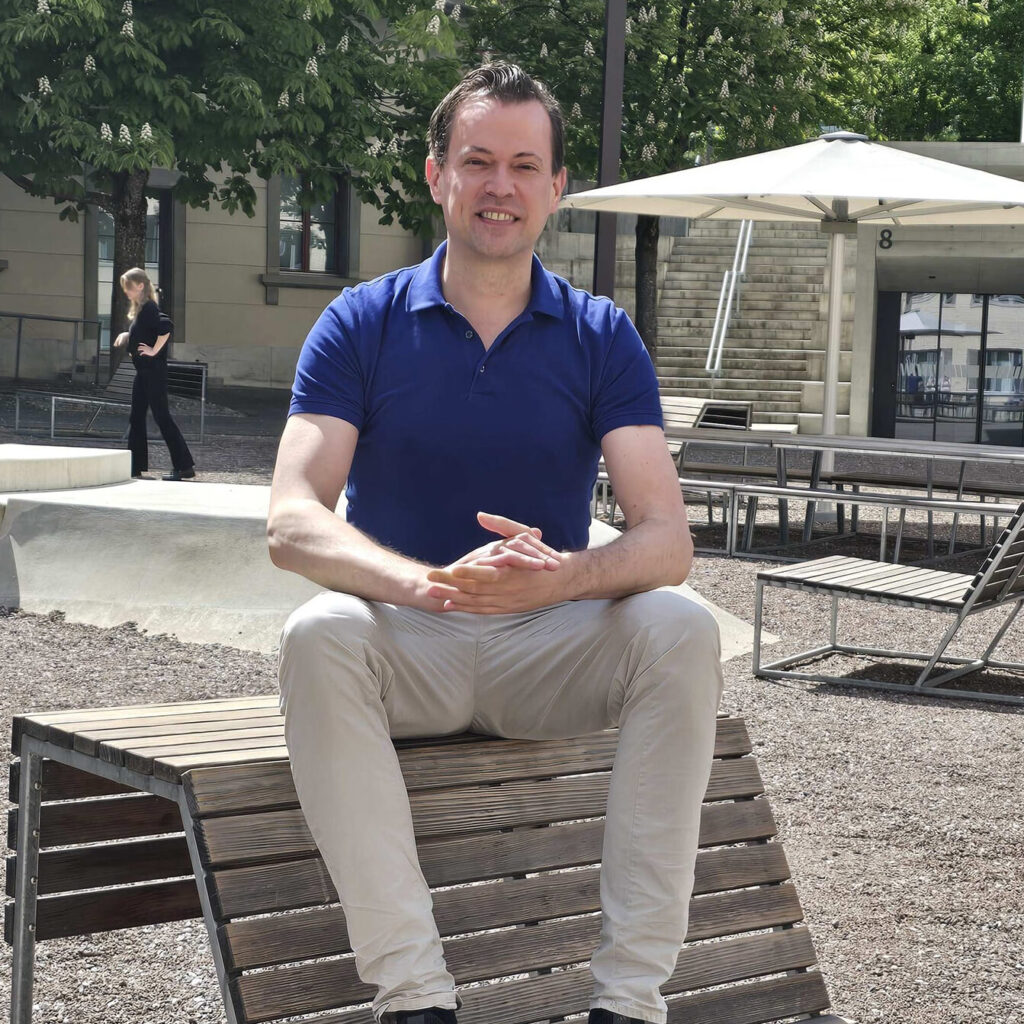
In April, the Institute for Organization and Human Resource Management at the University of Bern took over the scientific supervision of the Swiss LGBTI-Label. It now evaluates the submitted applications for new certifications and re-certifications and prepares a results report for each application. On this basis, the Awarding Committee then decides on the distinctions. PD Dr Thomas Köllen leads this work, and we asked him a few questions about his background and motivation.
Thomas, you have been connected to the Swiss LGBTI-Label for quite some time. When and how did you first come into contact with the Label? What did your involvement look like after that?
My contact with the Label came about through Andrea Gurtner, one of the Label’s co-initiators, who until recently was still a professor at the Bern University of Applied Sciences. We met in 2018 because we were both conducting research and publishing on LGBT-related topics in the workplace context. I naturally also became aware of the founding of the Label in 2018 and followed it closely. In 2020, I was then invited to become a member of the five-person Awarding Committee as the representative of the scientific side. I held this role until this year, when I took over the scientific agenda for the Label from Andrea and her team at BFH.
You specialized in gender and diversity during your academic career. What do you find particularly interesting about this field, and what topic are you currently working on?
When I began working on the topic of homosexuality in the work and organizational context as part of my doctoral thesis in 2005, one of the central motivating factors for me, in addition to my personal interest in the topic, was certainly the fact that there was still relatively little research in this area at the time. At the same time, a number of major European companies had already begun addressing the topic of “sexual orientation” as part of their diversity management programs. This opened up a fascinating field of research for me. One of the three companies that supported me during my doctoral thesis is now also certified with the Swiss LGBTI-Label.
After this entry into diversity research, I increasingly integrated the fields of gender identities and gender diversity into my research and teaching. More recently, I have also been working more intensively on “national identities” and nationalism in the organizational context, including in family businesses. Since every person always embodies some expression of every facet of diversity, meaning that no one is ever only lesbian, only Swiss, only Catholic, or only trans*, all these diversity topics are interconnected. This also means that LGBTI people cannot escape dynamics related to nationality and origin in the workplace. But the same, of course, applies to all other facets of diversity and to the processes that operate around them.
What motivates you now to take on this critical task for the Label?
I am very pleased about the trust that has been placed in me. The Label is a distinction that is unique in Europe, also because of its scientific foundation. Being able to contribute to preserving this special position and to continuously developing the Label is definitely motivation enough. Ideally, the Label should not only reflect the increasing degree of inclusion of LGBTI people in Swiss organizations, but also contribute to this positive development itself.
For the Label to have a broad impact and be widely accepted, it is certainly essential not to legitimize diversity and its inclusion one-sidedly through narratives about economic benefit, but above all through the fact that all people equally deserve to be treated with respect and to experience acceptance and recognition as exactly the people they are.
Who supports you in this work, and how is your team set up?
At the moment, my colleague Andrea Waser is a tremendous support to me at the Institute for Organization and Human Resource Management at the University of Bern. Andrea wrote an excellent master’s thesis under my supervision on the inclusion of trans people in Switzerland, and I am very glad that she is now part of the team and plays a key role in preparing the results reports. On the technical side, Olha Yarmolenko is also a very important support within the team.
From a scientific perspective: why should a company, or perhaps better, an organization, apply for the Label?
Through the application process, organizations gain a very good overview of where they currently stand at the level of measures related to LGBTI inclusion. If they are then certified, this is of course very strong confirmation that they are already on the right path. The Label itself can then be used to signal, both internally and externally and also at a symbolic level, the values the organization stands for.
The Label is, of course, not an end in itself. Ideally, it is the expression and evidence that the organization wants to ensure a working environment for its own workforce in which diverse sexual orientations, genders, and gender identities simply belong, and do not become the starting point for dynamics of exclusion related to work, careers, or professional life. The Label and the accompanying individual report then ideally document and confirm, every three years, the progress made through the organization’s own efforts, while also identifying the fields of action where there is still potential for improvement.
Which topics or areas of work are becoming more relevant in LGBTIQ+ DEI in the workplace? What are employees’ expectations of their companies in 2026? Can this be answered in general terms?
Thematically, the issue of non-binarity is certainly becoming increasingly important at the level of experienced and expressed gender. Many people, especially younger people, are simply no longer prepared or willing to constantly assign themselves, or be assigned, to one of two fixed predefined genders. Individual self-concepts may then lie somewhere in between, entirely outside this binary logic of gender, or may question or reject the category of gender as a whole.
In current inclusion practice, this naturally poses challenges for “classic” gender-related “equality initiatives.” In many organizations, these still make up the majority of inclusion efforts, often as measures explicitly aimed at promoting women. This, in turn, naturally creates a certain pressure toward binary self-identification and external identification within the gender spectrum, whether for strategic reasons or not.
For LGBTI inclusion, a dissolution or weakening of the category of “gender” is naturally also highly significant, since the minority and majority expressions “homo/hetero,” “trans/cis,” and “inter/endo” are only really defined through a binary understanding of gender in the first place. In any case, the accompanying reduction in the stigmatizing potential of being L, G, B, T, or I is a positive development.
What future developments will look like cannot, of course, be predicted. Or, to draw a little from the box of common phrases: every movement creates a countermovement, and every thesis always already contains its antithesis.
In connection with the second question, one can probably assume in general that, partly because social acceptance of LGBTI people in Western Europe has increased significantly over the past 30 years, people today are often less willing to hide or disguise who they are in their professional lives. However, there is of course a wide range of organizational contexts and individual experiences, which certainly also depend on the fields in which people work.